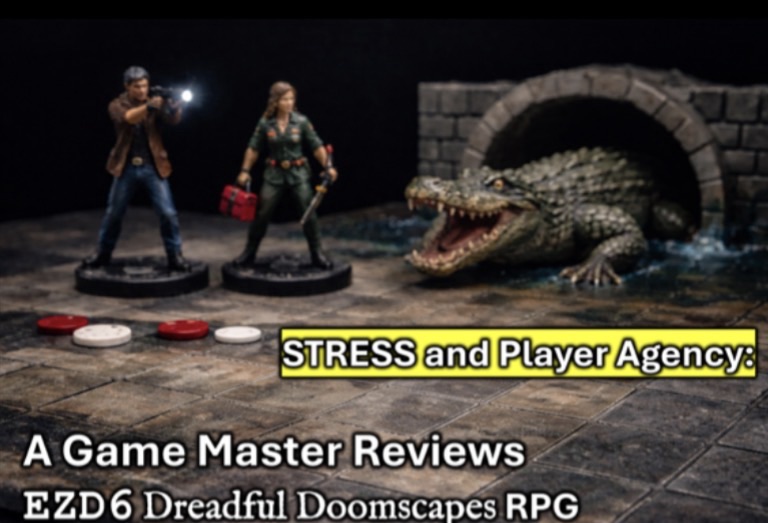
EZD6 continues to earn its place at my table as a reliable system for one-shots and short arcs. Dreadful Doomscapes, the newest playset expansion for Scotty McFarland’s EZD6 system, reinforces my assessment. These modern horror-genre rules do not reinvent the core engine. Gameplay refocuses encounters around something more measurable and immediate at the table: stress, as a player-facing resource that drives tension and agency.
Before getting into what works, it helps to understand what this book tries to do. Dreadful Doomscapes places modern-era characters into escalating danger. Scenarios feel familiar to anyone who grew up on monster-of-the-week television, such as Buffy the Vampire Slayer or Supernatural. Ordinary people, recognizable jobs, limited preparation, and situations that worsen the longer wannabe heroes stay in them. This framing strips away the safety nets that more fantastic systems often lean on. Players are not solving problems through optimized builds or long equipment lists. They make decisions under pressure.
Here is where the stress mechanic does its best work.
At its most basic level, stress allows a player to adjust the result of a d6 roll after seeing it. One point of stress proportionately raises the die result by one. If a player accumulates too much, three stress converts directly into one point of damage, and then resets. We teach this rule in under a minute, yet it re-shapes how players approach every roll that follows.
What stands out is not just that players can influence outcomes. Many systems offer some version of that twist. Rather, we see how an immediate and transparent decision gets made in real time. A player rolls, records the result, and decides whether the moment justifies the cost of their stress. There is no delay, no negotiation, and no abstraction between the choice and its consequence. The system places that decision directly in the player’s hands and resolves it in full view of the table.
This clarity carries through play. New players quickly grasp that failure is not final, yet the risk remains real. Experienced players begin to make decisions around group survival rather than individual success. The mechanic scales across skill levels without additional layers of rules or implied progression.
Pushing beyond the threshold reinforces the dynamic. Players can exceed safe limits to secure a desired result, resolve the action, and then absorb the fallout immediately afterwards. These sequences preserve competence in critical moments while ensuring that cost remains unavoidable. They also create memorable table moments, where success and consequence land almost at once. A subtle layer of peer pressure emerges as well, since everyone can see who is taking the risk.
The physical side of the system supports this loop. Tokens representing health and stress create a visible state that everyone at the table can read without asking. A player sitting behind a stack of stress tokens communicates something before they say a word. Other players adjust their decisions accordingly. A Game Master can sense when a scene is about to tip without checking a sheet or interrupting the flow.
That visibility pairs well with the d6 resolution system that EZD6 already uses. One die, clear targets, and minimal modifiers keep the focus on decisions rather than calculations. Stress integrates into that structure without adding complexity. Players do not learn a new subsystem. They decide how much they are willing to risk.
Character creation follows the same philosophy. Players begin with recognizable professions and a small set of defining traits. This grounding reduces the gap between player knowledge and character capability. Decision-making at the table tends to come from the situation rather than from a character build. In short-form play, time spent learning a character can easily outweigh time spent playing them, so this approach serves the format well.
Scenario design reinforces this structure. The included adventures model a clear sequence of escalating situations, giving Game Masters a template for pacing without locking them into rigid outcomes. Scenes move forward, pressure builds, and players find repeated opportunities to engage with the stress system. For someone new to running games, this structure provides a workable path from preparation to execution without demanding extensive system mastery or heavy preparation.
Credit to Scotty McFarland, especially through DMsCraft, for a long-standing focus on practical, table-ready design. That influence shows in how this playset prioritizes usability over density. Support from Runehammer appears in the tight focus on play rather than expansion.
Trade-offs deserve attention. Stress can become the dominant solution if every obstacle resolves through a single roll, so encounter design benefits from variety and layered challenges. Groups seeking long-term progression may find the structure better suited to short arcs than extended campaigns. These boundaries align with the playset’s goals.
Within those boundaries, Dreadful Doomscapes delivers a focused experience. Players control outcomes while accepting visible costs. Game Masters gain a framework that supports pacing without heavy preparation. Play stays centered on the table, where decisions, risks, and consequences remain in constant view.
For my own use, that combination keeps EZD6 at the top of the stack when I need a system that teaches quickly, runs cleanly, and produces meaningful play.
Enjoying this content? Share your thoughts with us and like minds.
Discover more from Autism at Face Value
Subscribe to get the latest posts sent to your email.

