By Dave Kot, MS
Running a tabletop role-playing game requires sustained judgment in uncertain situations. The Game Master responsibly paces a shared story by applying rules and maintaining social order. Autistic adults often hesitate to take on this role because current cultural narratives overvalue spontaneity and charisma. In practice, effective game mastery grows from preparation, expressed (not necessarily vocalized) clarity about how we communicate, and deliberate follow-through to generic housekeeping (read: scheduling next game, clean-up, and updating character inventories and new abilities).
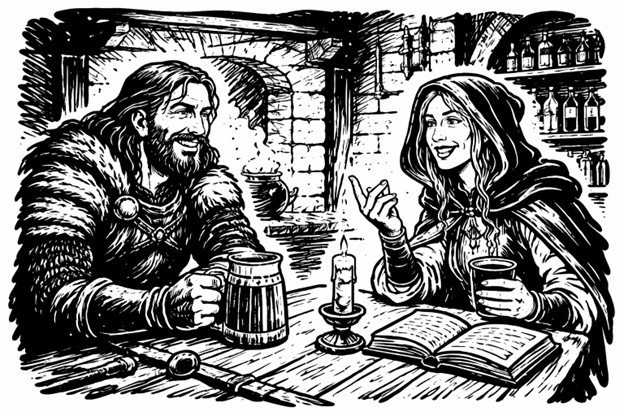
I write and run games as an autistic Game Master who understands how structure shapes engaging player participation. Clear systems, and preferably rules-lite systems, can help reduce role ambiguity and allow players to focus on meaningful decisions. When the table operates within an accepted, predictable framework, then the players spend less energy interpreting expectations and more energy engaging with the story. This dynamic supports accessibility without diluting challenge or creativity.
Your predictability reputation establishes functional authority at the table. Players trust facilitators who communicate unknown social expectations you already know, like: 1) session length, 2) explain how scenes resolve, and 3) adherence to consistent rules applications, with encouragement for players to learn the rules as they apply to their character. This trust does not depend on performance or persuasion, which are not common bulwarks among us with social processing challenges. Genuine trust emerges when procedures behave the same way each time uncertainty arises. I daresay: a well-prepared autistic game master can quickly rise in player demand and popularity by meeting their symptomatic needs for order and known (social) expectations.
Autistic facilitators often bring strengths well-suited to this work. Attention to detail supports consistent rulings. A preference for explicit rules clarifies boundaries. Commitment to preparation ensures that sessions unfold as intended rather than drifting under pressure.
Session Zero provides the foundation for this clarity. I use Session Zero to define how the table handles uncertainty, disagreement, and regulation. I explain how questions pause our gameplay, how rules guide resolution, and how players can step away without explanation when needed. These agreements remove hidden expectations and allow participation without masking.
Operational clarity benefits everyone at the table. Autistic players gain explicit guidance that reduces social strain. Neurotypical players gain a stable framework that supports collaboration, and this freedom allows players (and their characters) to grow and mature. The group shares responsibility for maintaining a functional environment, allowing them to reap the rewards of entertainment, too.
Adventure design continues this pattern of intentional structure. I organize original adventures around five discrete scenes, similar to John Fourr’s Five Room Dungeon model, with defined pressure rather than continuous narrative flow. Each scene presents a problem that invites a response, and then quickly concludes once that problem resolves. This approach limits cognitive overload and supports sustained attention for the next new thing.
Scene-based design allows flexibility without chaos. When players redirect the story, the facilitator adapts by reframing the next scene rather than rebuilding the entire narrative. Autistic Game Masters benefit from this modular structure because it externalizes planning and reduces improvisational and memory strains. Players experience coherence even as the story changes.
Rules function as shared reference systems within this structure. Transparent mechanics reduce personal tension, because we move from ambiguous decisions into an informal social contract through an agreed process. When facilitators apply rules(books) consistently, players understand agency and consequence without decoding subtext. This clarity supports equity across different communication styles.
Energy management remains central to sustainable play. Facilitation draws on attention and emotional regulation, both of which have limits. I schedule breaks, announce transitions, and end sessions before fatigue undermines judgment. These practices mirror standards used in education and group facilitation, so it seems smart to copy best practices from similar cohorts.
Leadership at the table appears through action rather than assertion. Prepared scenes, consistent rulings, and intentional pacing create an environment where players feel secure enough to take risks. Autistic Game Masters lead through competence grounded in self-awareness. Structure enables creativity rather than constraining it.
This work holds significance, especially within autism advocacy and community-based services. Families and partners often observe enjoyment without seeing the preparation that enables it. Naming this labor reframes game mastery as a skilled practice rooted in planning, observation, and care. These competencies translate into community engagement and sustainable small business models centered on accessibility.
Autistic and neurodivergent people already contribute meaningful leadership in structured, collaborative spaces. Tabletop roleplaying offers a visible context where these strengths support positive social exchange. Autism at Face Value invites parents, adults on the spectrum, and emerging facilitators to explore this work together. We welcome conversations about availability, participation, and the next steps toward inclusive play.
Love this content? TELL US. TELL YOUR FRIENDS. Subscribe & Share.
Discover more from Autism at Face Value
Subscribe to get the latest posts sent to your email.
 Autism at Face Value